
Leash Reactivity Training Class

Why Leash Reactivity Classes Didn't Work for You and Your Dog
Leash reactivity is the number one behavior problem for dogs in Chicago. You will find various group classes and memberships in the area focused on leash reactivity, but we do things differently here.
In the average “leash reactivity group class,” all of the dogs are put in a classroom with visual barriers (opaque fences) in between them. They learn some training skills and then very slowly are exposed to a “demo dog” popping into their view and moving away. Typically, some progress is made in the classroom, and everything falls apart on neighborhood walks. The training plan moves too slowly, and the owner and dog are left struggling.
The Rehearsal Issue
Every time a dog lunges and barks on the leash, the habit of leash reactivity is further solidified. Leash reactivity training needs to move as fast as possible so that these events can be stopped.
Management and Distance
Typical leash reactivity training programs tell you to avoid the problem while you work on training. While this is sound advice, it is not practical for most dog owners in Chicago. Dogs are everywhere! When working on leash reactivity in the city, an aggressive and consistent training plan is needed to get the training dog working comfortably around other dogs as soon as possible.
A Group of All-Reactive Dogs
A group of all-reactive dogs together in one room is a bad vibe. Even if they can’t see each other, the dogs know that other dogs are there. Stress hormones fill the room. Some dogs feel trapped because they are indoors. Dogs hear each other whine and bark, and it echoes off the walls. It’s difficult to take breaks because you are trapped in a maze of visual barriers. This is no fun!
The Solution
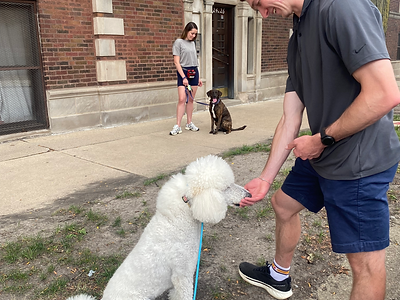
Instead of integrating reactive dogs into group class by putting them with a group of other reactive dogs, I mix my recovering leash reactivity cases into my regular group classes – usually starting with my outdoor class Teamwork on the Town. The more experienced students in my classes act as positive role models for the new students, showing them how to be well-behaved.
Working outdoors allows dogs to take breaks and regulate naturally by sniffing, exploring, and stretching their legs – something that is not possible in small indoor classes.
Foundations
Most students need help first with foundational training skills (basic obedience, leash handling skills, etc.) and a group setting is not an appropriate environment to teach those skills for a dog with leash reactivity. At least 1 private lesson is required before joining group class. Click here to read more about private lessons.
Contact us to discuss what your leash reactive dog is ready for.

A group of dogs calmly practicing settling around one another. The majority of the dogs in this photo have a history of leash reactivity.
The V&MK9 Promise
The Venus and Mars K9 difference is that dogs prone to leash reactivity are not treated like freaks or weirdos and kept in separate classes for the rest of their lives. Some dog trainers might try to convince you that you need to keep buying special courses for reactivity, or stay in special support groups indefinitely. While it is true that some dogs’ temperaments fundamentally make for a challenging training puzzle, it is also true that many trainers will make you feel like your dog is worse than they actually are – either because the trainer lacks skill, or because this is a business scheme to take more of your money.
Even if your dog’s reactivity is not 100% “solved” yet, we strive to integrate them into “normal” life as soon as possible – while of course ensuring that you and your dog are healthy, happy, and not overwhelmed. Please reach out if you have any questions about this system!
Why Does Your Dog Bark On Leash?
The following are excerpts from my full-length guide about leash reactivity.
Leash Reactivity Definition
"Leash reactivity" refers to a range of behaviors that mainly occur when your dog is on a leash. These behaviors might include freezing, pulling, whining, growling, lunging, barking, or snapping – at another dog, a human, other animals, bikes, skateboards, scooters, etc.
Do "Leash Aggression" and "Leash Reactivity" Mean the Same Thing? Is All Reactivity Aggressive?
"Leash reactivity" is a large umbrella term for the behaviors described above. Some leash reactivity has an aggressive emotion that you can feel. Some leash reactivity leads to further aggressive behavior such as attempting to bite another dog or even "redirecting" onto the owner. However, not all leash reactivity is aggressive in nature, and some dogs are leash reactive towards dogs and people even though they are friendly or social when off leash.
Leash Reactivity Cause(s)
Dogs can be experiencing one or more of these head-spaces while behaving reactively:
-
Demand barking at the dog for attention
-
Frustration
-
Predatory
-
Invitation to fight
-
Fear
-
Defensiveness
-
Space seeking
-
Surprise or startling
-
Alarming/alerting
-
And more…

How Do We Fix Leash Reactivity? Do I Just Need More Positive Reinforcement?
The exact training plan is going to depend on your individual dog and your lifestyle. Overall, we use a combination of well-trained formal skills, counter-conditioning, and desensitization/habituation. Exposure with graduating levels of challenge is typically done in set-ups created with reliable helper dogs under the guidance of the trainer. You can read more about exact techniques, including troubleshooting, in the full-length guide about leash reactivity.
How Long Does It Take to Train a Reactive Dog?
It depends! Sometimes even leash reactivity that appears very dramatic can be fixed in one or two sessions. Some dogs have stronger emotions and habits, and training can take several months. You should feel like you are making significant progress within 2-3 weeks, and the trainer can normally predict approximately how long things will take after the first couple of sessions.
Does My Dog Need More Social Skills?
Fearful dogs in particular oftentimes benefit from building their confidence through growing their social skills. However, not all dogs are social butterflies, and even introverts can learn to calmly coexist around others. We call this practicing "neutrality."

"Formerly Leash Reactive" Testimonials
Giovanna & Enzo
"I cannot speak highly enough of Cori. We began our journey with 1-on-1 sessions to address my dog's anxiety, reactivity, loose leash walking, and over-excitement. Cori's expertise and dedication were evident from the start.
Under their guidance, my dog's behavior has undergone a remarkable transformation. Cori's approach is both personalized and effective. They encouraged us to participate in group classes, even though I was initially nervous due to my dog's selectiveness with unfamiliar dogs. Cori keeps in mind dogs different skill levels and comfortability by managing distractions and visibility of other dogs.
Cori's genuine care for the success of both my dog and me sets them apart. We've been working with Cori for almost three years, and I wouldn't want to train with anyone else. Cori makes training enjoyable and shows you how to seamlessly incorporate it into everyday tasks.
I trust Cori completely and would follow them anywhere! Whenever I have questions, Cori is always ready to help, breaking down solutions for both me and my dog. I recommend Cori to everyone seeking professional, caring, and effective dog training. Cori truly is the best!"
Michelle & Storm
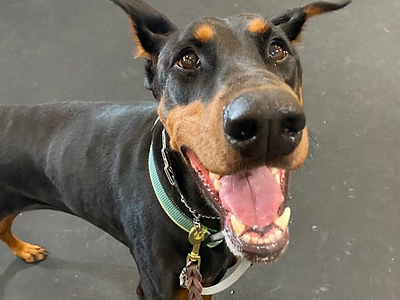
"Wow, Cori is a dream dog trainer and expert in dog behavior. I started working with them to help my THEN-reactive 5 yr old Doberman pinscher rescue (aptly named Storm) take the first steps to feel more comfortable around other dogs. I think what stands out about Cori’s approach are 3 things: 1) their realism about expectations and possibilities that training can provide, which was different from the dogma (no pun intended) about how “if you didn’t train your dog before age 2 they’re a lost cause” or “this 2 week board and train will solve everything” — Cori saw all the potential and worked to get us there. 2) step by step guides, videos, and feasible “homework” specially tailored for me and Storm to practice and work our way up to our goals. 3) deep understanding of dog behavior — Cori works to tackle root causes and the depth of their experience helps them easily “diagnose” what’s going on in any given situation.
The results over the past year of working with them have been astounding; my friends who knew Storm before ask me HOW DID YOU DO THAT?! Before, Storm couldn’t be within 20-30 ft of another dog without completely losing it. Barking, lunging, and and generally getting out of control - being 85 lbs this was becoming a safety issue. Bit by bit we worked to increase her confidence and build on the tools to actually get her to a place where she can socialize (albeit awkwardly) with other dogs. Cori devised a totally custom strategy for this that included group classes, 1:1’s, 2 week board and train, and calls to discuss homework. Fast forward, Storm now has a couple select dog friends, can even play in the park with other dogs! She still has her quirks and sometimes meets a dog that sets her off, but now we have the actual tools and SKILLS deeply engrained that can help us navigate. I don’t even have to ask her for a “down” when another dog is approaching. Storm does it on her own — because she knows it’s a safe space where she’s confident in herself. That’s the type of behavior change that Cori prioritizes in their work.
Last thing - I recently boarded Storm with Cori and honestly was a little jealous that I couldn’t get in on the fun :P They went on all sorts of adventures and pack walks and Storm came home even more confident around other dogs. Highly recommend all around."